
New Year’s Day
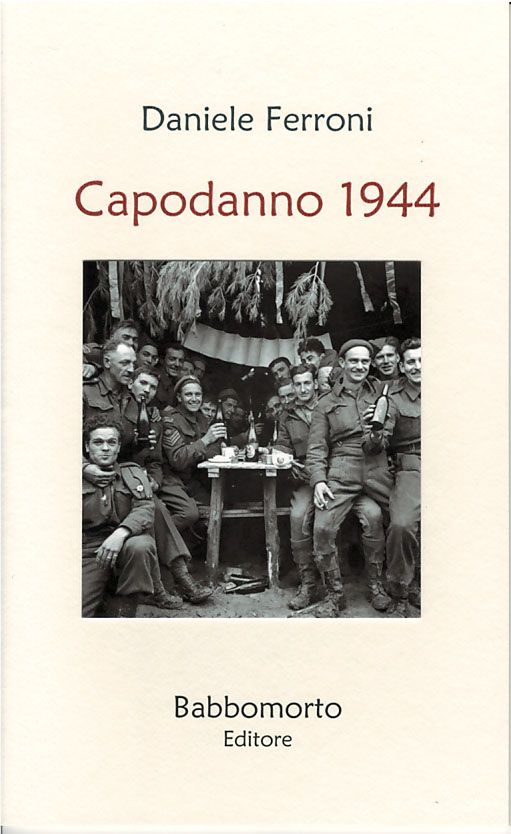
New Year’s Day Villanova di Bagnacavallo (Ra), Tuesday 3 – Monday 9 January 2023
It was just after dawn on Wednesday December13, 1944, Saint Lucia’s Day, a couple of days after the liberation of the small village of Villanova di Bagnacavallo, in the countryside of Ravenna, from the Nazi-Fascists. Canadian troops were settling into the houses of that area, especially those along Via Aguta Superiore, in order to reorganize before delivering the final blow to the German troops, who still occupied nearby Bagnacavallo. At number 14 of that street, in a huge farmhouse, lived the large Poletti family, led by Antonio, a gentle and kind-hearted man. Some platoons of the Cape Breton and the Lord Strathcona’s Horse Regiment, infantrymen and tank crews, had taken quarters in the vicinity of that house, since part of it already served as a large kitchen. It was during those days that Roberto, one of the youngest of the Poletti brood, befriended “Leo” John Malley, tank commander of a Sherman with a 105 mm gun. He was one of those young Canadian volunteers always ready to laugh and joke. Roberto, who was six years old at the time, soon became the troop’s mascot and was especially taken under John’s wing. He would often ride with him inside the tank during reconnaissance patrols. Christmas—yet another Christmas in wartime—was approaching, and preparations began in view of celebrating it in that very area,. Some people were cleaning and decorating the vast cowshed, which was divided into eight stalls to house as many pairs of cows or calves—four on each side, while others tidied the loggia, the barn, and the large rooms. At that time the house sheltered ninety-three people, families displaced from nearby hamlets such as Villa Prati, Masiera, and Rossetta, where fighting was still raging and part of the territory remained occupied. The Canadians requested a list of everyone’s names and prepared a gift for each person. At last, people were able to eat decently again. The cooks prepared the food, which was then divided and distributed among soldiers and civilians. Hardly a day went by without a couple of trucks unloading crates of white bread, which hadn’t been seen in those parts for years. Antonio, the head of the family who had agreed to host the evacuees, was a deeply faithful man. When asked how they would manage to feed everyone he would reply in dialect: La pruvideza la s’aiutarà!” (Providence will help us!). And indeed, the Canadians had arrived. Before their arrival, the household stores consisted only of two large oak barrels, normally used to aging wine—one filled with beans and the other with potatoes—along with half a sack of corn and some wheat. Every morning, early in the morning, the grains were ground in varying amounts and mixed with water, to form a dough. Primo, Roberto’s uncle, baked it in the wood-fired oven located opposite the house, the same oven later used by the Canadians to prepared meals for the troops. They ate that sort of flatbread for lunch and dinner, with the addition of potatoes and, when possible, an onion or some cabbage found who knows where. That was how they endured, waiting for liberation. With the arrival of the young men of the Lord Strathcona’s Horse and the Cape Breton, everything improved. Now the fire was kept constantly burning, and the enormous stoves, also wood-fired, had to be fed with whatever could be recovered locally, in the countryside and in houses already plundered by retreating German troops. In the days before Christmas, John loaded Roberto onto his tank and drove not far from the front line, along Via Cocchi, the road connecting Villanova with Villa Prati. From a house near the Fosso Vecchio, half-destroyed by mortar fire, they retrieved a massive beam, so as to make firewood for the kitchen stoves and perhaps keep part of it as a “Christmas Log” to burn in the fireplace until Epiphany as a sign of good fortune for the coming year. When they returned home, the Poletti men were waiting. Angry and shaken, they shouted at John: “Are you crazy taking a child so close to the front line!” In fact, where they had gather the firewood, the Germans could be seen even with the naked eye, behind the Bellingegni house, where despite the cold, bathing outdoors in a huge tub used for grape must during harvest. John looked at the Polettis and, with the candor and lightheartedness of his twenty-three years, and replied simply “Ah… but we went with the tank!” There was little to say in response. After all, he had his reasons. So everyone burst out laughing and, exchanging pats on the back, returned to their tasks. A Christmas tree had been set up under the loggia: it was a field elm from the nearby vineyard, blown apart during the days of liberation. Each person contributed something to decorate and embellish it. The younger children, using red candy wrappers, had curled and tied them in the center with thin string so that they looked like many small, beautiful butterflies. The older ones with folds and counter-folds had fashioned doves and little angels from the silver foil of cigarette packs brought by the soldiers. Doves and angels: symbols of peace, of the peace so deeply needed. Neria, the azdòra (mistress) of the household, had baked and hung biscuits shaped like stars or chicks—the latter a bit out of place—warning especially the little ones not to look at them, let alone eat them, at least until Christmas Night. There were also some tangerines and three or four oranges hanging from the tree. On Christmas Eve, a great celebration was held, and for a while no one thought of the war. They sang Christmas carols such as Astro del ciel, paired with Douce Nuit Sainte Nuit. One verse was sung by the Romagnoli and one by the Canadian boys. They danced in the enormous stable: Canadians with Italians, children and grandmothers, mothers with fathers who had recently returned home. Meanwhile, the troops at the front were gaining ground day by day, and by now all the enemy forces had been pushed beyond the Senio River, … which would remain the front line throughout the winter of 1944 -1945. The friendship between John and Roberto had become like the bond between brothers, despite the many years between them. For New Year’s Eve, John—now well-liked throughout the area—was commissioned to go and fetch a musician to liven up that party. In the village there were many who, with one instrument or another, enlivened evenings in taverns or at dances, in exchange for good wine and food. The choice fell on a certain Buldoz (Bartolo Balducci), who lived in Via Cocchi, between the intersections of Via Aguta and Via Superiore. Naturally, John traveled in his tank. Having loaded Roberto onto the turret and armed themselves with a huge typha bag full of cigarettes, they arrived at Buldoz’s house. The sight of a tank in one’s courtyard could hardly bring joy; indeed, poor Bartolo nearly soiled himself with fear. Roberto reassured him: “Stasì tranquel! J è canadis, j è bona zent! I vô, ch’a suniva sta nöt par la fësta dl’ùltum dl’âñ!” (Stay calm! They’re Canadians, good people! They want you to play tonight for the New Year’s Eve celebration.) At the same time, John picked up the bag full of cigarettes and showed him its contents, opening it by the handles. The two things combined, along with the desire to return—even if only briefly— to the carefree lifestyle of his past, convinced the musician. Once the musician was loaded aboard, as they maneuvered out of the gate, the tank’s long gun struck a corner of the house; the wall immediately collapsed, turning Bartolo pale as he nearly fainted. Once again, however, the youngest member of the expedition reassured him: “Stasì tranquel! I canadis, j è pî d’baioch e i v’arpêga ignaquël!” (Stay calm! The Canadians are full of money and will repay you for everything!). The fact is that suddenly and as an addition, Bartolo found both his kitchen and bedroom completely gutted. Buldoz played the accordion and, together with Bert and Garson, formed the most sought-after trio of musicians. The night slipped by quickly to the notes of popular Romagna songs, of tresconi and saltarelli, with the hint of some pieces that Buldoz tried to interpret after this or that soldier had hummed or whistled the tune, as best he could, in his ear. The Canadians were pranksters and not “stiff” like the British, who arrived in the months that followed. So, in the middle of the night, in agreement with their commander—who was also present at the revelry—they decided to wish the Germans a “Happy New Year” in their own way. They loaded the guns and each tank fired a round toward Alfonsine, shouting: “Bonne année!” John, whose thank carried the 105 mm gun, had been expressly forbidden by the Platoon Leader to fire, lest he shatter every window in the house. Not wishing to be left out, John gave his driver a knowing glance, and pretending to have a bodily need, slipped through the small door that led from the stable to the back of the house, next to the manure pit where he usually left his vehicle, and with a cunning attitude had it started. No one except the youngest noticed that move. The tank took the farm track that from the house that runs parallel to Via Cocchi, still leads to the border with the Contessi’s fields. There it stopped. John must have thought it wouldn’t do any damage at that range. He loaded the enormous cannon and… boom! He fired a single shot! The tank, from the recoil, jolted backward, making them burst into roaring laughter, like when people have fun on the merry-go-round at village fairs. When they returned home they found everyone there, silent and with arms folded, waiting for them. Some, out of fear, had even sobered up. All the windows in the house, especially those facing the farm track, had shattered into a thousand pieces. The bystanders looked at him in silence—he was standing in the middle of the stable, with the children all around him. Then the highest-ranking officer stepped forward, struggling to suppress his laughter, and began to give John what seemed a stern reprimand. Soon after, the celebration resumed even more noisily than before. In the days that followed, from January 3 to 7, the Germans counterattacked fiercely, at points breaking through Allied lines near the church of the Abbadesse, then at the double bend of Via Chiara, near the Quercioli mill, and at Conventello along Via Basilica. It was in those days that John gave his young life for the freedom of those who now write and remember him. Little Roberto also saw him lying on the ground, composed as if asleep, the familiar smile still on his lips. He lay beside others, between the old well and that loggia that had witnessed their joy at Christmas and New Year’s.